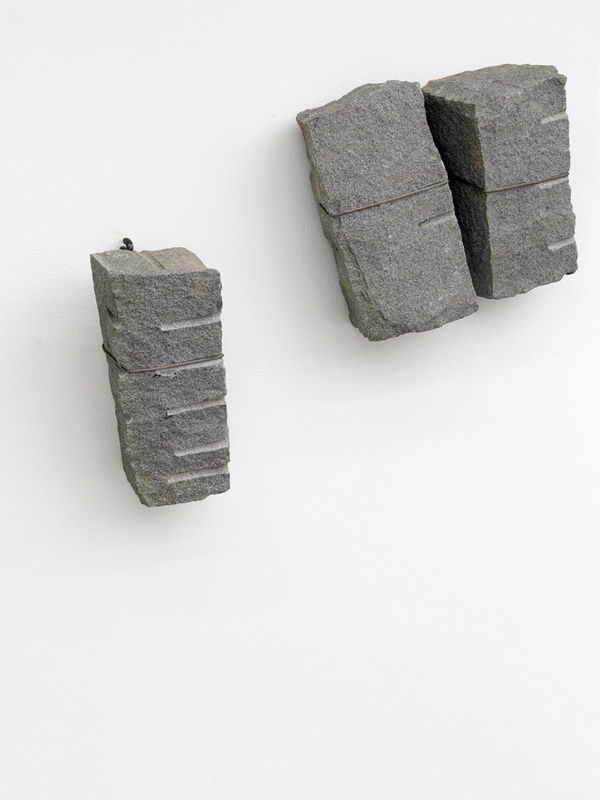
A key figure of Arte Povera whose work challenged and redefined the limits of material and perception
Widely recognized as one of the central figures of Arte Povera in the late 1960s, Giovanni Anselmo (1934-2023) would go on to expand his artistic practice beyond the confines of this historical designation. Throughout his career, Anselmo explored the dynamic relationship between nature and culture, the finite and the infinite, the visible and the invisible. Conceiving each work as a living organism-apparently static yet constantly transforming-he frequently returned to earlier pieces, developing new iterations that responded to context, time, and material change.
His first solo exhibition at Konrad Fischer Galerie took place in 1996. His work has since been presented internationally, including exhibitions at the Renaissance Society, Chicago (1997); Palais des Beaux-Arts, Brussels (2002); Museum Kurhaus Kleve (2004); Stedelijk Museum, Ghent (2005); Kunstmuseum Winterthur (2013); Castello di Rivoli, Turin (2016); Fondazione Querini Stampalia, Venice (2017); Accademia Nazionale di San Luca, Rome (2018); Guggenheim Museum Bilbao (2024); and MAXXI – National Museum of 21st Century Arts, Rome (2024).
Anselmo also took part in major international exhibitions, including the Venice Biennale in 1978, 1980, and again in 1990, when he was awarded the Golden Lion. He also participated in Documenta V (1972) and Documenta VII (1982), further affirming his position as one of the most influential artists of his generation.