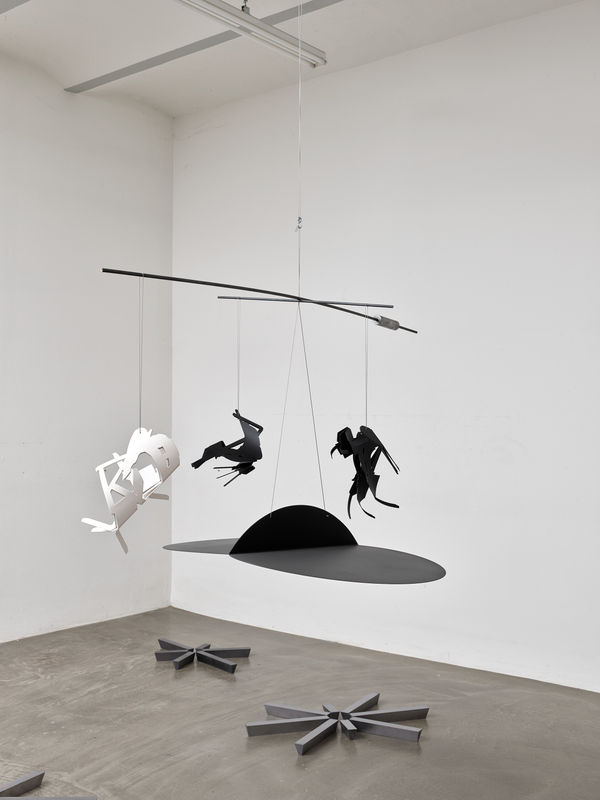
Since the mid-1980s, Harald Klingelhöller has occupied a unique position at the intersection of sculpture and language. Defining himself as a “linguistic flaneur,” he transforms the written and spoken word into three-dimensional form. His practice creates a tension between narrative elements and visual art, employing a wide range of materials—from fragile paper, cardboard, and glass mirrors to heavy steel and granite.
Klingelhöller’s sculptures can be read as spatial transcriptions of language, playing with intonation, repetition, and the linear flow of letters. The metaphorical and poetic phrases he utilizes—drawn from the press, poetry, or medical and legal texts—are far more than mere titles. Instead, they establish a framework where language and object coexist without ever being entirely congruent. It is precisely this lack of congruence that Klingelhöller explores: the unpredictable relationship between the word and the parallel world of objects.
This open-ended dialogue allows his oeuvre to serve as a metaphor for a specific understanding of art: one that insists on the autonomy of the work while simultaneously inviting discourse on its meaning. His work has been celebrated internationally for decades, with major presentations including Skulptur Projekte Münster (1987), the Whitechapel Gallery in London (1990), documenta 9 (1992), and extensive solo exhibitions at the Lenbachhaus Munich (1997) and the Museu Serralves in Porto (2007). More recently, Klingelhöller’s work was featured in the 2020–21 exhibition Die Welt erzählt (zweifach, sternförmig) at Konrad Fischer Galerie, Berlin, and in 2022’s Schneefall erzählt at the Skulpturenhalle – Thomas Schütte Foundation in Neuss. He also presented work in Routes Après la Pluie (Double, En Forme d’étoile) at Galerie Jocelyn Wolff in Paris in 2021.
His first exhibition with Konrad Fischer took place in 1991. Klingelhöller lives and works in Düsseldorf and Karlsruhe and has taught for many years at the Kunstakademie Düsseldorf and previously at the Staatliche Akademie der Bildenden Künste Karlsruhe, where his engagement with language and form has informed both his teaching and artistic practice.