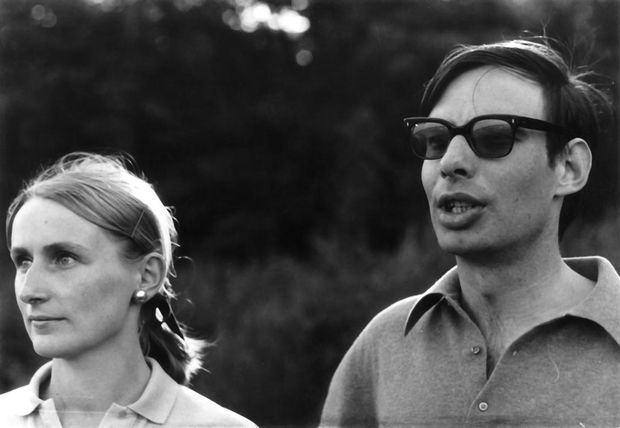
When Konrad and Dorothee Fischer opened their modest exhibition space in a disused alley in the center of Düsseldorf in October 1967 with a presentation of works by Carl Andre, Minimal and Conceptual Art were still largely unknown in Europe. Yet this small space-soon known as Ausstellungen bei Konrad Fischer - quickly became a pioneering platform for a generation of artists who would go on to redefine contemporary art. Many of the most influential figures of that period, including Richard Long, Bruce Nauman, Sol LeWitt, On Kawara, Lawrence Weiner, Hanne Darboven, and Robert Ryman, held their first European solo exhibitions at the gallery. Their association with the gallery has continued ever since.
From the outset, Konrad and Dorothee Fischer's approach was distinctive: rather than merely exhibiting works, they invited artists themselves to Düsseldorf. This practice fostered an international network of collaboration and exchange, while also giving rise to the creation of site-specific sculptures, paintings, and installations. It was here that Daniel Buren first introduced his spatial interventions, Gilbert & George presented their now-iconic Singing Sculpture, and Wolfgang Laib installed his delicate works in beeswax and pollen. The gallery also championed new conceptual developments in painting and photography, presenting works by Robert Mangold, Alan Charlton, Bernd and Hilla Becher and Jan Dibbets. Shortly after the emergence of Arte Povera, the gallery introduced its leading figures-Giuseppe Penone, Giovanni Anselmo, Mario Merz, and Jannis Kounellis-to a broader European audience.
Over the following decades, the gallery's program expanded to include artists such as Tony Cragg, Harald Klingelhöller, Rita McBride, Thomas Ruff, Thomas Schütte, and Jerry Zeniuk. In subsequent years, a new generation of artists, among them Guy Ben-Ner, Peter Buggenhout, Aleana Egan, Jim Lambie, Manfred Pernice, Magnus Plessen, Wolfgang Plöger, Gregor Schneider and Paloma Varga Weisz joined the gallery, continuing its legacy of innovation and dialogue between artistic movements and generations.
In 2007, Konrad Fischer Galerie opened an additional space in Berlin, extending its commitment to both emerging international positions and the sustained presentation of the gallery's nearly five decades of artistic history.
Today, under the direction of Berta Fischer, the gallery remains a vital institution in the international contemporary art landscape.